
AI for coding interviews can help you organise an approach to a spoken programming question and explain its trade-offs. Interview Copilot includes a Coding mode and live answer guidance; you still need to understand, implement and test the solution within the interview's rules.
The useful test is whether you can explain the approach after the suggestion is gone. A code block alone does not show that you understand repeated inputs, boundary cases or the cost of the algorithm. Use the worked example below to assess those parts separately.
What Copilot does in a coding round
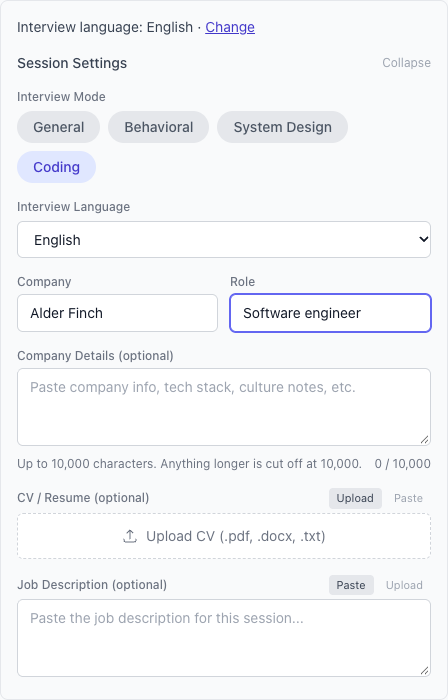
Interview Copilot's current site lists coding alongside behavioral, system design and general modes. Its coding illustration shows a spoken two-sum question, hash-map reasoning and a code example. That establishes the published guidance workflow; it does not establish that Copilot can read every coding platform or execute your solution.
For live help, connect a supported interviewer-audio source and check that the spoken question reaches the transcript. Use Manual Get Answer, available on every plan, when you want guidance. Basic and Intensive also include optional Auto Answer after a question ends.
The three answer formats are Cue me, Structure it and Formulate my answer. Try a concise cue when you know the technique but need a reminder. Try an outline when you need to organise clarification, approach, complexity and tests. Check the complete response for mistakes before relying on any detail.
Worked example: find the first unique character
This is an original teaching example written for this guide, not a customer session, benchmark or captured Copilot response.
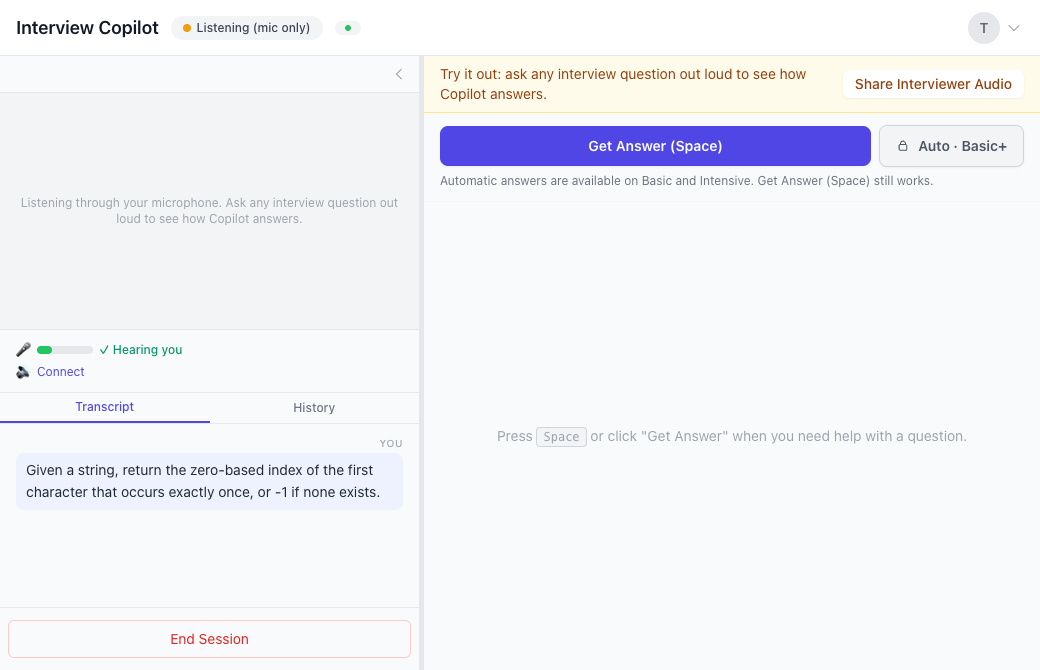
Problem: Given a string, return the index of the first character that occurs exactly once. Return -1 if no character is unique.
Clarify the contract before solving it. For this example, use zero-based indices, treat uppercase and lowercase as different characters, and define a character as a Python string element. If the interviewer means user-perceived characters or byte offsets, agree a different contract before writing code.
For "swiss", the answer is 1 because w appears once and comes before the other unique character, i. For "aabb", return -1. For the empty string, also return -1.
Start with an approach, then write code
A direct approach is to inspect each character and count its occurrences by scanning the whole string again. With n characters and a scan for each one, that takes quadratic time. It is easy to describe, but it repeats work.
Instead, count every character once in a dictionary. Then walk through the original string in order and return the first index whose character has a count of one. The second pass preserves the “first” part of the requirement; the frequency map alone does not tell you which answer to return without considering order.
def first_unique_index(text):
    counts = {}
    for character in text:
        counts[character] = counts.get(character, 0) + 1

    for index, character in enumerate(text):
        if counts[character] == 1:
            return index

    return -1
Under the usual average constant-time dictionary-operation assumption, the two passes take O(n) time. The dictionary uses O(k) additional space, where k is the number of distinct characters. If your input alphabet is fixed and small, you can discuss a fixed-size counter array instead; say which assumption makes that substitution valid.
Trace the example out loud
For "swiss", the first pass records s: 3, w: 1 and i: 1. On the second pass, index 0 fails because s appears three times. Index 1 succeeds because w appears once, so the function returns 1.
A concise explanation might be: “I'll separate counting from selection. First I count the characters, then I scan the original order for the first count of one. That is two linear passes with a dictionary for the distinct characters.” This explanation is editorial example wording, not a promised product response.
Now ask a follow-up: “Could you return the character instead of its index?” The change is small, but it checks whether you know what the function returns and where the return value is chosen. A second follow-up, “What if the string arrives as a stream?” changes the problem more substantially; do not claim the same two-pass implementation solves an unbounded stream unchanged.
Test the contract, not just the happy path
Try an empty string, a one-character string, all repeats, a unique character at the end, and mixed case. For this contract, "aab" returns 2 and "Aa" returns 0. If a suggestion returns a character instead of an index, it solves a different contract even if its counting logic is correct.
When asking Copilot for guidance, make sure the spoken requirement and any clarified constraints are available in the transcript or supplied context. This guide does not promise automatic access to an editor, screen-only prompt, repository or test runner.
Prepare the audio and practice paths separately
Free includes 20 Copilot minutes and 20 Coach minutes every month. On Free, Copilot starts with your microphone. During the session, Share Interviewer Audio adds your call tab in Chrome or Edge on a computer.
For a live call, use the supported route described in the Zoom, Teams or Meet guide, then verify another speaker's words. See pricing for allowances and AI interview practice for preparation. Coach's technical mock format is verbal, not a coding editor.
Frequently asked questions
Does Interview Copilot include Coding mode?
Yes. The current site lists coding, behavioral, system design and general rounds. This guide focuses on spoken questions, approach and explanation.
Does this guide show actual Copilot output?
No. The problem, explanation, code and test cases are writer-created teaching material.
Can Copilot execute the code for me?
This guide makes no execution or test-runner claim. Run and inspect the solution in the environment permitted for your interview.
Can I practise coding in Coach?
The published technical mock format is verbal, not coded. Use it for spoken explanation; use a separate permitted coding environment to implement and test.
What should I check in an AI coding answer?
Check the input/output contract, assumptions, algorithm, complexity and edge cases. Then explain the solution without reading the suggestion and answer a follow-up.
Try Copilot free. Read the Interview Copilot overview and live-answer guide for the product workflow.